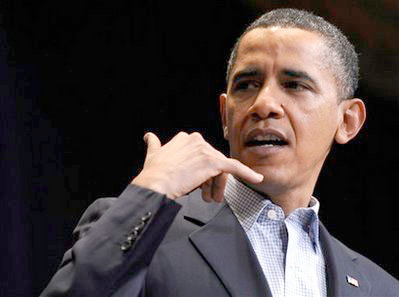
 US
President Barack Obama delivers remarks at the Democratic National
Committee Winter Meeting in Washington, Feb 6, 2010. [Agencies] US
President Barack Obama delivers remarks at the Democratic National
Committee Winter Meeting in Washington, Feb 6, 2010. [Agencies] |
WASHINGTON: US
President Barack Obama says it's time for Republicans who have attacked
his health care proposals from the sidelines to step before the cameras
and present their own ideas.
In the first major
move to revive his health care agenda after his party's loss of a
filibuster-proof Senate majority, Obama on Sunday invited GOP and
Democratic leaders to discuss possible compromises in a televised
gathering later this month.
It comes amid widespread complaints that Democrats' efforts so far have been too partisan and secretive.
The Feb 25 meeting's
prospects for success are far from clear. GOP leaders demanded Sunday
that Democrats start from scratch, and White House aides said Obama had
no plans to do so.
"If we are to reach a
bipartisan consensus, the White House can start by shelving the current
health spending bill," said Senate Minority Leader Mitch McConnell,
R-Ky.
But
House Majority Leader Steny Hoyer, D-Md., said his earlier efforts to
reach out to Republicans "did not result in any serious follow through
to work together in a bipartisan fashion."
Obama told CBS's
Katie Couric that he and the leaders of both parties will "go through
systematically all the best ideas that are out there and move it
forward."
Asked if he was
willing to start from square one, the president said he wants "to look
at the Republican ideas that are out there."
"If we can go step by
step through a series of these issues and arrive at some agreements,"
Obama said, "then procedurally, there's no reason why we can't do it a
lot faster than the process took last year."
Democratic and
Republican leaders in Congress have differed sharply on most major
questions in the long-running health care debate. Only one Republican
voted for the health care bill that the House approved in December, and
no Republicans voted for a similar Senate version.
White House officials said Sunday that Obama does not intend to restart the health care legislative process from scratch.
Many liberal groups
and lawmakers want congressional Democrats to use all the parliamentary
muscle they have to enact the measure that the Senate passed on
Christmas Eve, employing rules that could bypass GOP filibusters to
make changes demanded by House Democrats.
The White House has
not ruled out such a strategy. But Obama's recent talk of inviting
Republican input and extending the debate for several weeks has caused
uncertainty about his plans.
A White House
statement Sunday said Obama repeatedly has made it clear "that he's
adamant about passing comprehensive reform similar to the bills passed
by the House and the Senate."
Polls show that many
Americans feel Obama and his congressional allies have not sought
enough GOP input, although Democrats say Republicans have shown
virtually no interest in seeking a realistic agreement.
Obama also is trying
to address criticism of Democrats' closed-door negotiations that led to
special accommodations for Nebraska and Louisiana senators when their
votes on health care were in question. Some Republicans taunted Obama
for suggesting earlier that health care negotiations should be aired on
C-SPAN, and one GOP senator said health care would be the president's
Waterloo.
Obama said the closed-door deal-cutting was not helpful to the process.
Senate Majority
Leader Harry Reid, D-Nev., said, "we have promoted the pursuit of a
bipartisan approach to health reform from day one."


 پسورد فایل: www.downloadha.com


 دانلود نسخه جاوا
 حجم فایل : ۵۹۴ کیلوبایت
  پسورد فایل ها :




 امروزه فناوری اطلاعات به سرعت در حال گسترش است. تا چندی پیش اتصال به اینترنت به یکی از سه روش زیر محدود شده بود که هر کدام کاستی ها و مشکلاتی داشتند:
 نخست، دسترسی از طریق خط تلفن به صورت
  دوم، دسترسی از طریق خط تلفن با استفاده از فناوری
 اما اکنون با ظهور وایمکس جهان در آستانه تحولی دیگر در عصر اینترنت قرار گرفته است.

 سلام من این وبلاگ را برای دوستداران فیزیک و بازی های رایانه ای ساخته ام تا آن هارا در انجام امور و کارهایشان کمک کنم شما نیز با نظر هایتان مارا همراهی کنید.